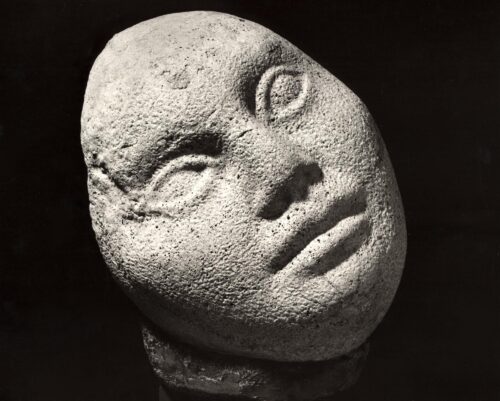
Vagis Polygnotos (1894 - 1965)
Moon, 1940
He took his first sculpture lessons from his father, who was a carpenter. In 1911 he immigrated to New York and in 1917 he enrolled in the Sculpture Department of the Cooper Union, where he attended classes for six months. The following year he enrolled in the Institute of Fine Arts in New York and studied for three years. In 1932 he received a scholarship from the Whitney Museum Club that helped him maintain a workshop until 1933. In 1958 he was honored with the Audubon Artists Gold Medal and in 1962 with the Phoenix Gold Cross. Shortly before his death he bequeathed his works to the Greek state. In 1981, the Polygnotos Vagis Museum was founded in Potamia, Thassos.
He presented his work in solo exhibitions in New York, while in 1977 a posthumous retrospective exhibition was held in Kavala. He has also participated in exhibitions at the National Academy of Design in New York and has participated in group exhibitions, including at the Brooklyn Museum of Art, the Metropolitan Museum and the Whitney Museum of American Art in New York, as well as at the Museum of Fine Arts in Houston.
His works, which are mostly human figures, animals and compositions that he carves directly into stone, wood or cement, are dominated by a generalization and rough processing that echoes primitive or Greek art of the archaic period.
Moon, 1940
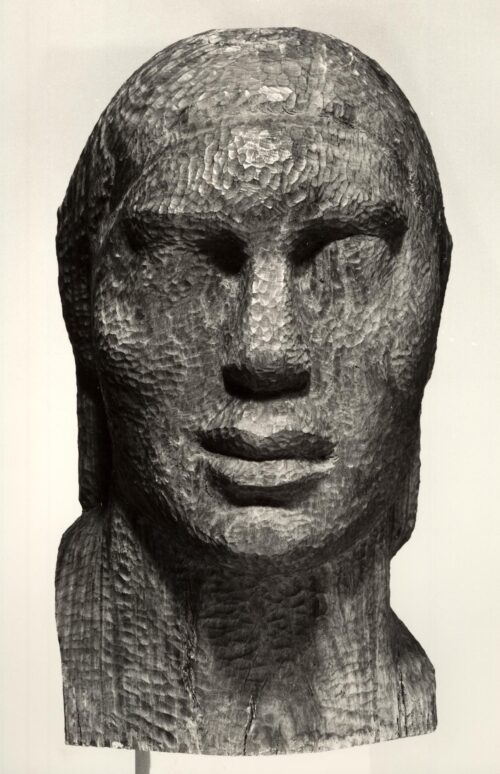
Head of a Woman, [before 1946]