March at the National Gallery – Alexandros Soutsos Museum is bringing new exhibitions, musical encounters, and a variety of diverse activities for the public.
The exhibition of Helene Pavlopoulou titled Zoephoros opens at the Nafplion Annex. The works in the exhibition engage in a dialogue with works from the Annex’s permanent collection, aiming to explore new ways of viewing, to seek multiple meanings, and to reinterpret the past through the eyes of the present.
Concurrently, the exhibition Irene Aperghis: archive – furniture & decoration – painting continues at the Contemporary Greek Art Institute (ISET), as do the performances of Konstantinos Hatzis’ theatrical work Medea. Exodus III, in which Euripides “converses” with Yannoulis Chalepas in the evocative space of the National Glyptotheque. Furthermore, at the Central Building of the National Gallery, the third musical meeting with the Athens Classical Players will take place, titled Spring Symphony – 19th Century. Finally, as every month, educational workshops and guided tours will be held at the National Gallery also in March.
We invite all of you to participate this month as well in a comprehensive programme of exhibitions and events that highlights the interdisciplinary dialogue between the arts and the timeless value of artistic expression.
National Gallery – Central Building
Musical Event
Painters and Composers meeting in time: Spring Symphony – 19th Century
Athens Classical Players
As part of the musical program Painters and Composers Meeting in Time, the National Gallery hosts the third concert titled Spring Symphony – 19th Century on March 18.
Masterpieces of classical Western music converse with contemporary works from the Museum’s permanent collection in a series of short concerts with the Athens Classical Players. This meeting highlights the unique aesthetic resonance and artistic currents of each century, in both Painting and Music.
Both the musical compositions and paintings are presented together so that the audience can better understand the shared ideas, aesthetic elements, and artistic trends of the era. The key elements of the programme are: the common techniques of composition and form; the use of colours (in painting) and timbres (in music); and the morphological and stylistic developments of artistic media.
The program is curated by Iris Louka. The musical works selected represent primary examples of their time and are thematically linked to the artworks presented from the permanent collection.
The event is designed to be accessible to people with mobility impairments and wheelchair users, as well as to people with visual impairments.
The venue of the central building of the National Gallery is designed to accommodate people with mobility impairments and wheelchair users, right from the entrance and the concert hall to the exhibition halls, ensuring their comfortable and safe participation.
For people with visual impairments, there will be:
– an organized tactile tour that will take place before the start of the concert
– audio descriptions of the two paintings.
Those wishing to participate in the tactile tour are kindly requested to register in time by filling out the following Google Form by Monday, March 16, to ensure the best possible experience for everyone:
3rd Concert
Spring Symphony – 19th Century
March 18, 2026, 19:30
National Gallery – Alexandros Soutsos Museum, Central Building
Admission is free.
No seat reservation is required.
An entrance ticket for the Permanent Exhibition of the National Gallery is required.
Paintings:
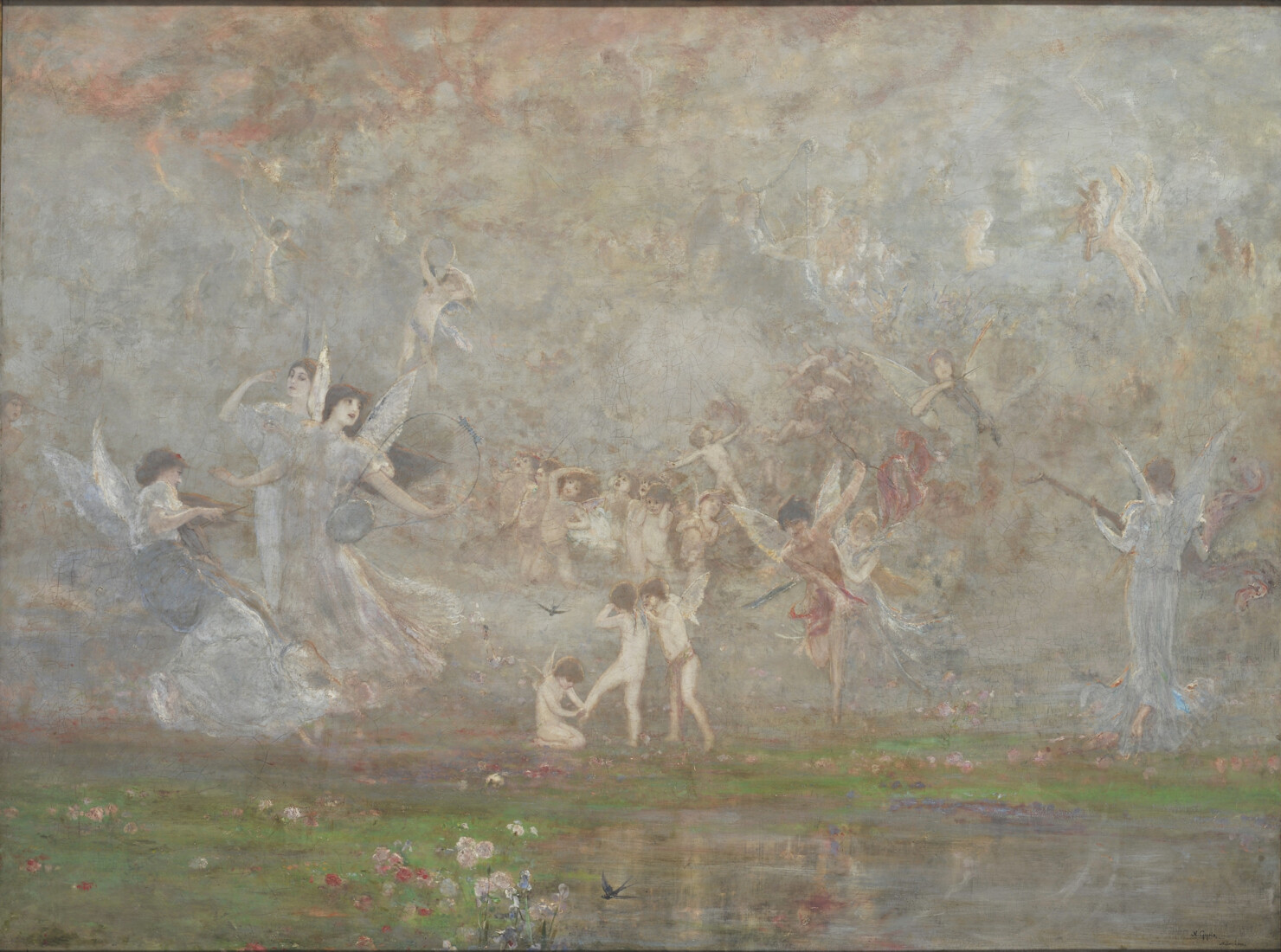
Nikolaos Gyzis (1842-1901) Spring Symphony
I. Aivazovsky (1817-1900) Men on Rocks
Musical Works:
Ludwig van Beethoven (1770-1827)
String Trio in C Minor 1st mvt (9′)
Violin: Iris Louka
Viola: Tania Charitopoulou
Cello: Nora Karakousoglou
Franz Schubert (1797-1827)
String Quartet “Death and the Maiden” 1st mvt (15′)
Violins: Giorgos Mandilas, Christoforos Karathanasis
Viola: Antilochos Tranos
Cello: Asterios Pouftis
Johannes Brahms (1833-1897)
Clarinet Quintet, 1st mvt (9’)
Clarinet: Spyros Mourikis
Violins: Ioanna Gaitani, Iris Louka
Viola: Tania Charitopoulou
Cello: Asterios Pouftis
Piotr I. Tchaikovsky (1840-1893)
Souvenir de Florence for string sextet
1st mvt (10′)
Violins: Maria Tsogia-Razakova, Iris Louka
Violas: Antilochos Tranos, Petros Vlassis
Cellos: Asterios Pouftis, Nora Karakousoglou
National Glyptotheque
Medea Exodus III
Konstantinos Hatzis
Euripides “converses” with Yannoulis Chalepas at the National Glyptotheque.
Following Medea through a verbatim reading of Euripides’ play, the theatrical performance focuses on her journey as a symbol of “uprooting.” A refugee, torn from her homeland, Colchis, she arrives in a second home — the city of Corinth — without any political rights. She is doubly exiled: from her homeland and her kin, experiencing social exclusion as a “foreigner” as well as the exile of the soul, betrayed by the god eros/demon in the person of Jason.
Three performers narrate the story of Medea, incorporating fragments of words from Medea and Jocasta by Giannis Kontrafouris into the text.
The performance unfolds at the National Glyptotheque and “converses” with the eponymous work by one of the greatest Greek sculptors, Yannoulis Chalepas, Medea III (Plaster, 72 × 44 × 26 cm), through the lighting “presences” and the particular reflections of the glass case, offering impressive, different visual perspectives to every viewer.
The performance Medea. Exodus III highlights the philosophical dimension of uprooting, the eternal displacement of female populations, the female entity, the conflict with the identity of the “foreigner,” the harsh integration into “new homelands,” and social exclusion.
Venue: National Glyptotheque, Alsos Stratou, Goudi
Dates: February 25 to March 15, Wednesday to Sunday
Start time: 19:30
Duration: 70’
Entrance fee: 15€
Presale here
Credits:
Direction/Text Compilation/Adaptation: Konstantinos Hatzis
Butoh: Ioanna Garagouni
Lighting/Costumes: Chroma Group
Photographs: Angelos Hill
Performers:
Gina Thliveri
Thanos Stasinos
Konstantinos Hatzis
The performance Medea. Exodus III is held under the auspices and with the financial support of the Ministry of Culture.
The performance is in Greek.
Annex of the National Gallery – Alexandros Soutsos Museum – Nafplion
HELENE PAVLOPOULOU
Zoephoros
The Nafplion Annexe of the National Gallery – Alexandros Soutsos Museum hosts in the temporary exhibition hall an exhibition dedicated to the paintings of Helene Pavlopoulou titled Zoephoros.
The exhibition includes twenty-one artworks which converse with the historical paintings of the permanent collection of the Nafplion Annexe of the National Gallery – Alexandros Soutsos Museum. The goal of the exhibition is not the representation of visual reality but the investigation of new ways of viewing, the search for multiple meanings, and the reinterpretation of the past through the lens of the present. Concepts of freedom and its reclamation, as well as references to the elements and the preservation of our natural environment, constitute major axes of the painter’s personal visual vocabulary.
Helene Pavlopoulou’s visual universe includes many symbolic places: the Parthenon, Athens, Arcadia; It also includes prominent figures: Georgios Gemistos-Plethon, Manuel Chrysoloras, Voltaire, Rigas Feraios, Heroes of the 1821 Revolution, Ioannis Kapodistrias; and symbols such as birds, plants, horses, and fragments of ancient sculptures. Using these archetypes, the painter stands among them in an eternal response, harmoniously condensing them in the limited space of the artwork and transforming socio-political and historical events into powerful poetic allegories.
The bicentenary of the Greek Revolution was a source of inspiration for Helene Pavlopoulou, who rendered the portraits of the fighters in an ethereal, allusive way. Through this transcription, she highlighted the persistent presence of the past in the present and the future, pointing out that the Revolution remains alive within the cracks of time. Drawing inspiration primarily from the portraits of the Bavarian painter Karl Krazeisen (1794 – 1878), she reinterprets the faces of the heroes as markers of collective memory, transcending the bonds of matter and activating the viewer’s emotion for the completion of their image.
The collection of works in this exhibition demonstrates how Helene Pavlopoulou transforms the past into a new universe of dynamic lines and dreamlike diffusion of the colour spectrum, restoring the image of lost unity with nature. Through her works, she approaches timeless themes and invites viewers into a dialogue, underlining the relationship of the art of painting with memory, as the act of painting keeps the traces of past figures and forms alive.
Opening: Saturday, March 28, 20:00
Nafplion Annexe of the National Gallery – Alexandros Soutsos Museum
Sidiras Merarchias 23, Nafplion
General Direction: Syrago Tsiara
Exhibition Curator: Lambrini Karakourti-Orfanopoulou
Production Coordination: Eirini-Dafni Sapka
Visual Identity: A4 DESIGN
Duration: March 28, 2026 – January 17, 2027
ISET – Institute of Contemporary Greek Art
IRENE APERGHIS: archive – furniture & decoration – painting
The exhibition IRENE APERGHIS: archive – furniture & decoration – painting maps out important milestones in Aperghis’ artistic research, from her early experiments in geometric abstraction, which characterize her “return” to painting, to the dynamic wall compositions in irregular formats, in which she abandons the convention of the canvas. All the works on display belong to the collection of the National Gallery –Alexandros Soutsos Museum (EPMAS), which acquired them through purchases —already from Aperghis’ first solo exhibition in 1979— through the Maria Dimitriadi Bequest, of whose gallery hosted four solo exhibitions of Aperghis, as well as following the recent donation by Georges Aperghis.
Before “returning” to painting in the mid-1970s, Irene Aperghis, following her studies at the Athens School of Fine Arts (1939–1948), worked for approximately twenty-five years as a freelance furniture designer and interior decorator. Presented in the exhibition for the first time, furniture designs and painted watercolors of interior layouts and furnishings from Aperghis’ archive reveal a largely neglected dimension of her professional practice. This archival material, which —like the Irene Aperghis’ archive in its entirety— survive thanks to the meticulous “archival care” of her friend, the visual artist Diohanti, illuminate in a unique way the social history of furniture and the transformations of the domestic interior in postwar Greece, shaped by rapid urbanization, intensive reconstruction, and processes of “modernization.”
In 2019, the archive of Irene Aperghis, along with that of her husband, the sculptor Achilleas Aperghis (1909–1986), was donated to the Contemporary Greek Art Institute.
Artistic Direction: Syrago Tsiara, Director of the National Gallery
Head of ISET (National Gallery Annex): Natasa Tsaropoulou
Exhibition curator: Eugenia Alexaki, Art Historian
Exhibition architectural design: Eirini – Daphne Sapka
Exhibition coordination: Eirini – Daphne Sapka, Natasa Tsaropoulou
Opening: Thursday, February 19, 2026, at 7:00 PM
Duration: until May 15, 2026
ISET – Institute of Contemporary Greek Art, 9A Valaoritou, Athens
Exhibition opening hours: Monday – Friday, 10:00 AM – 6:00 PM